Printable DnD magic item cards: why they matter
Physical magic item cards transform how loot lands at the table. A practical guide to rarity, attunement, scope, and the cards worth printing.
There’s a moment in every campaign where a player finds a magic item and the energy in the room dips. The DM reads the item name out loud, recites the mechanics from a stat block, and the player nods, writes it on their character sheet, and moves on. The item, which the DM spent half an hour choosing and seeding, registers as a footnote.
Physical magic item cards fix this. The card lands on the table. The player picks it up. They read it themselves. They show it to the rogue. It becomes a thing they own, not a line on a sheet.
If you’re sold on the idea and you want to know what to look for in a printable card set, here’s the practical version.
The problem with announcing loot out loud
Verbal loot has three failure modes.
It’s forgotten. A player who heard the description once will not remember the recharge condition, the attunement requirements, or the specific damage type two sessions later. They’ll either ask the DM mid-combat (slowing things down) or they’ll just play the item wrong (which is worse).
It’s invisible to the rest of the party. Only the player who got the item really knows what it does. The cleric doesn’t know the fighter has boots of the winterlands until the fighter mentions it. Coordination suffers.
It doesn’t feel like an object. “You find a +1 longsword” is not loot. “You find Frostbite, a longsword whose blade is etched with runes that frost over when drawn,” presented as an actual card with the item’s name and properties printed on it, is loot. The card does the work the DM’s narration was already trying to do.
Physical cards solve all three. The information is permanent and re-readable. It sits on the table where teammates can see it. And the card itself is the object. It’s the thing the player keeps.
What good magic item cards include
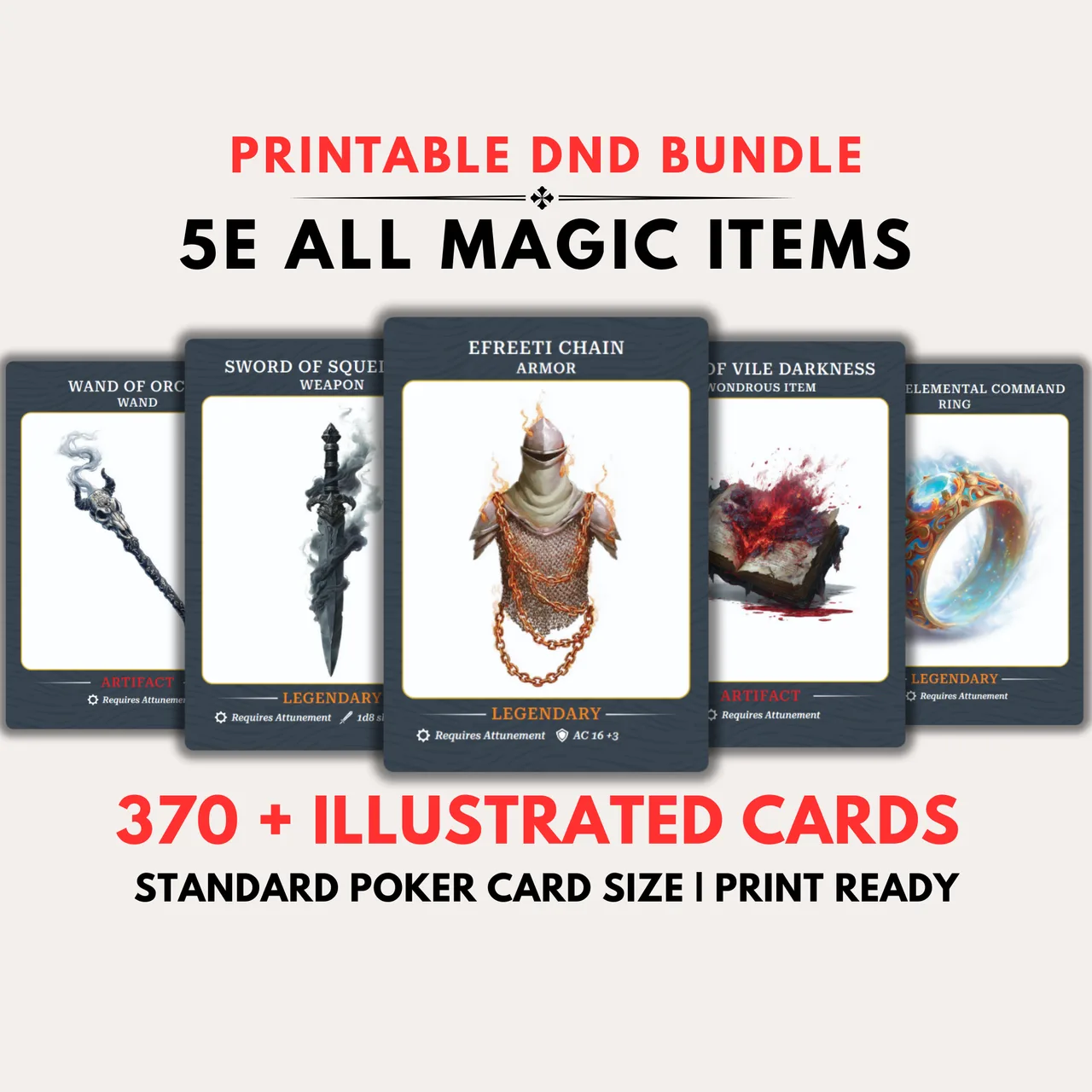
Not all magic item cards are equal. A good card includes:
- Item name large enough to read across the table
- Type (weapon, wondrous item, armour, potion, scroll, etc.)
- Rarity with a colour tag or border that’s recognisable at a glance
- Attunement requirement clearly marked, not buried in the body text
- Mechanical text in full, not abbreviated, not “see PHB”
- Charges or recharge condition if applicable, formatted so it’s easy to track
- A piece of art that suggests what the item looks like
A bad card has half this information and assumes the DM will narrate the rest. That defeats the point. The whole reason for using cards is that the DM doesn’t have to narrate the rest.
Rarity color-coding and why it matters
5e uses six rarity tiers: common, uncommon, rare, very rare, legendary, and artefact. Most well-designed item cards colour-code these: green for uncommon, blue for rare, purple for very rare, orange for legendary, and so on (the exact colours vary, but the pattern is consistent across many sets).
This isn’t decoration. It’s a usability feature.
When a player has six magic items in their inventory, they should be able to glance at the cards and know which ones are the powerful items and which are the utility items, without reading every description. Colour-coded rarity does that instantly. It also helps the DM. When you’re laying out treasure for an encounter and you want to drop one rare item in a pile of uncommons, the colour tells you which is which without having to re-read each card.
Rarity colour-coding also reinforces the in-fiction sense that some items are special. A green-bordered card and an orange-bordered card don’t feel the same when you put them next to each other. That’s a free narrative beat.
Attunement tracking with physical cards
Attunement is the rule new DMs forget most often. Players collect attunement items, exceed the three-slot limit, and nobody catches it because it’s all written on a character sheet that nobody re-reads.
With physical cards, attunement becomes visible. A common convention: turn attuned cards horizontally (sideways) and unattuned items vertically (upright). Now the player can see at a glance which of their items they’re currently using, and the DM can see whether they’re at the cap.
Some groups go further and use small sleeves or markers on attuned cards. Whatever the convention, the key point is: attunement is no longer invisible bookkeeping. It’s right there on the table.
How many cards do you actually need?
This depends on your campaign style.
Low-magic campaign: A party of four might end a level 1 to 10 campaign with 6 to 10 magic items between them. You need maybe 30 cards in your DM library to have options.
Standard campaign: Most 5e games run at slightly above the suggested loot rate. A party will accumulate 15 to 25 items by tier 3. You want a library of 100+ cards to have flexibility.
High-magic campaign: Some tables hand out items every session. A party might accumulate 40+ items, including potions and scrolls. You want a library of 200+ cards.
For most DMs, a comprehensive bundle (300+ cards) is “buy once, use forever” territory. You’ll never run out of options, you’ll never have to make your own card from scratch mid-session, and you’ll have items appropriate for every tier and every party composition.
The MakeMythic magic item card collection
The Magic Item Cards 800+ Illustrated Bundle ($90 $27.00) is built for the “comprehensive library” use case. It holds 800+ items covering every rarity tier from common to legendary, every item type from weapons to wondrous items to potions, with consistent illustrated art on every card and proper rarity colour-coding throughout.
The bundle is sized so a single DM can run an entire multi-year campaign without ever needing another item card. It’s one of the larger upfront purchases on the shop, but the per-card cost works out to under 20p, and it’s a print-at-home PDF, so there’s no shipping and no waiting, and you can re-print any card as many times as you need (useful when a player loses a card, which they will).
Ability cards: the companion set worth knowing about
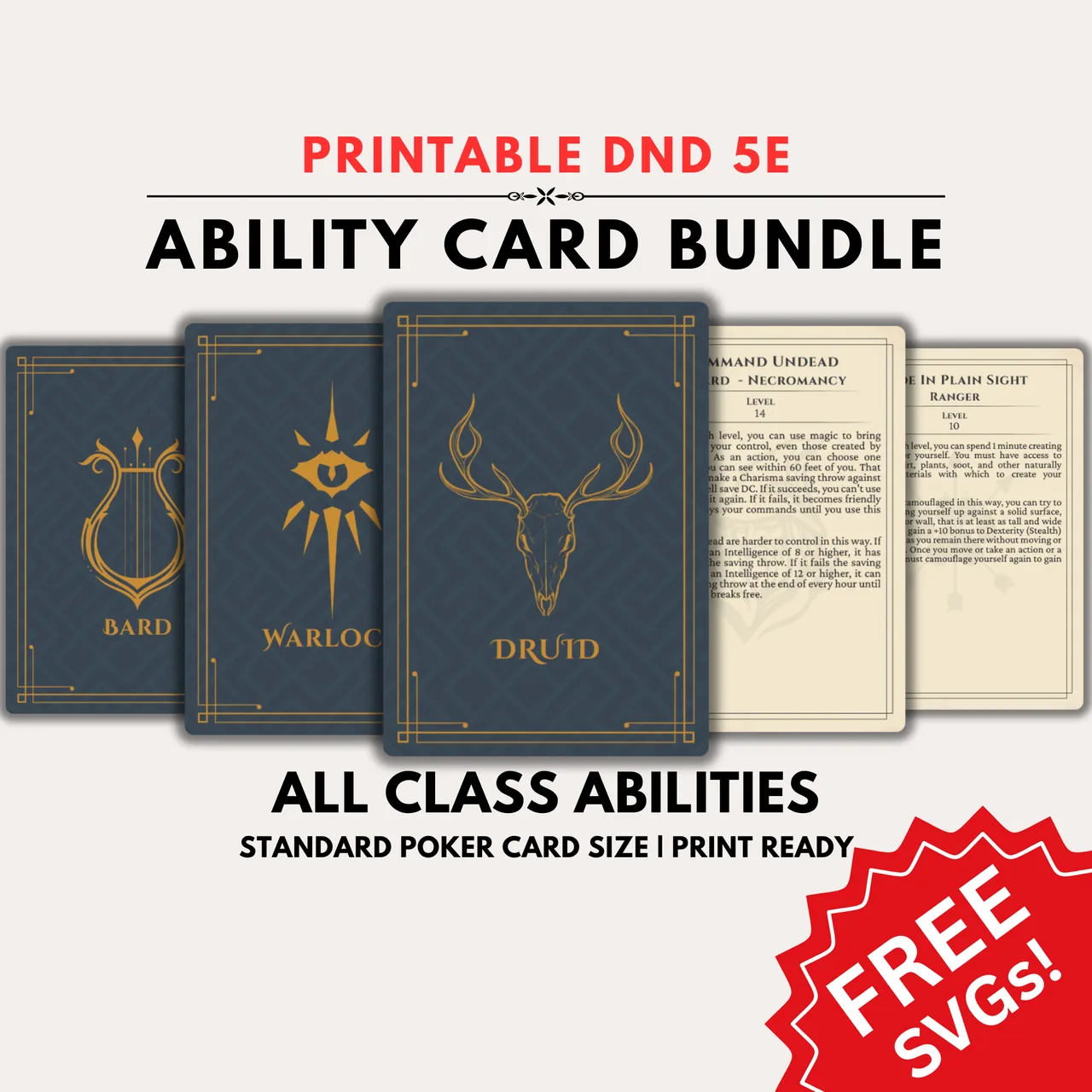
Magic items aren’t the only thing players forget. Class abilities, especially the conditional ones like sneak attack, bardic inspiration, or channel divinity, get missed all the time. New players especially will play half a session before remembering they have a feature that would have changed three rolls.
The Ability Cards All Classes Bundle ($61 $18.30) is the same idea applied to class features. Every class, every subclass, every level, printed as cards the player keeps in front of them. The fighter who never remembered they had Action Surge will remember now, because the card is staring at them.
Used together with magic item cards, ability cards turn a character sheet into a deck. Players sort their cards by what’s recharged on a short rest vs a long rest. They flip cards face-down when used. The bookkeeping that used to live on a wrinkled sheet of paper now lives in a tactile, visible system on the table.
That’s the bigger point. Cards aren’t a gimmick. They’re a way of making the rules play themselves, so the DM and players can spend more time on the story.
Frequently asked questions
- How many magic item cards do I need for a D&D campaign?
- A low-magic campaign needs around 30 cards in your DM library. A standard campaign benefits from 100+. A high-magic or long-running campaign is best served by 200+ cards. A complete bundle of 800+ covers any campaign style without ever needing to make a card from scratch.
- What should a good magic item card include?
- Item name (large enough to read across the table), type, rarity with colour coding, attunement requirement clearly marked, full mechanical text (not abbreviated), charges and recharge conditions, and an illustration.
- How do you track attunement with physical magic item cards?
- Turn attuned item cards sideways and keep unattuned items upright. This makes your three attunement slots visible at a glance for both the player and the DM, without any extra bookkeeping.
- Can magic item cards be used for scrolls and treasure handouts?
- Yes. Handing a player the actual card for a scroll they find is one of the best uses of a magic item card library. The card becomes a prop they keep until cast, making the scroll feel like a real object.
- Where can I buy printable DnD magic item cards?
- MakeMythic on Etsy sells a 800+ illustrated magic item card bundle covering all rarities from common to legendary, formatted as an instant-download PDF you can print at home or at a print shop.
Keep reading
From the shop
Battlemaps, spell cards, and magic item cards, ready to print.
Browse MakeMythic on Etsy →