Printable DnD spell cards: a 5e guide
Physical spell cards change how players engage with their spells. A practical guide to sizes, illustrations, edition coverage, and how DMs use them too.
Spell cards are one of those small table upgrades that quietly fixes problems you stopped noticing. Players stop flicking through the Player’s Handbook mid-turn. Casters actually remember what their level 3 slots can do. The DM stops adjudicating “wait, does fireball end on save or just half damage?” twice an hour. The cards do the work the rulebook can’t, because the rulebook isn’t sitting face-up next to your dice.
If you’ve already decided you want printable DnD spell cards, this is the guide to the choices that actually matter: size, illustration, edition coverage, and how to use them at the table.
Why casters need physical spell cards
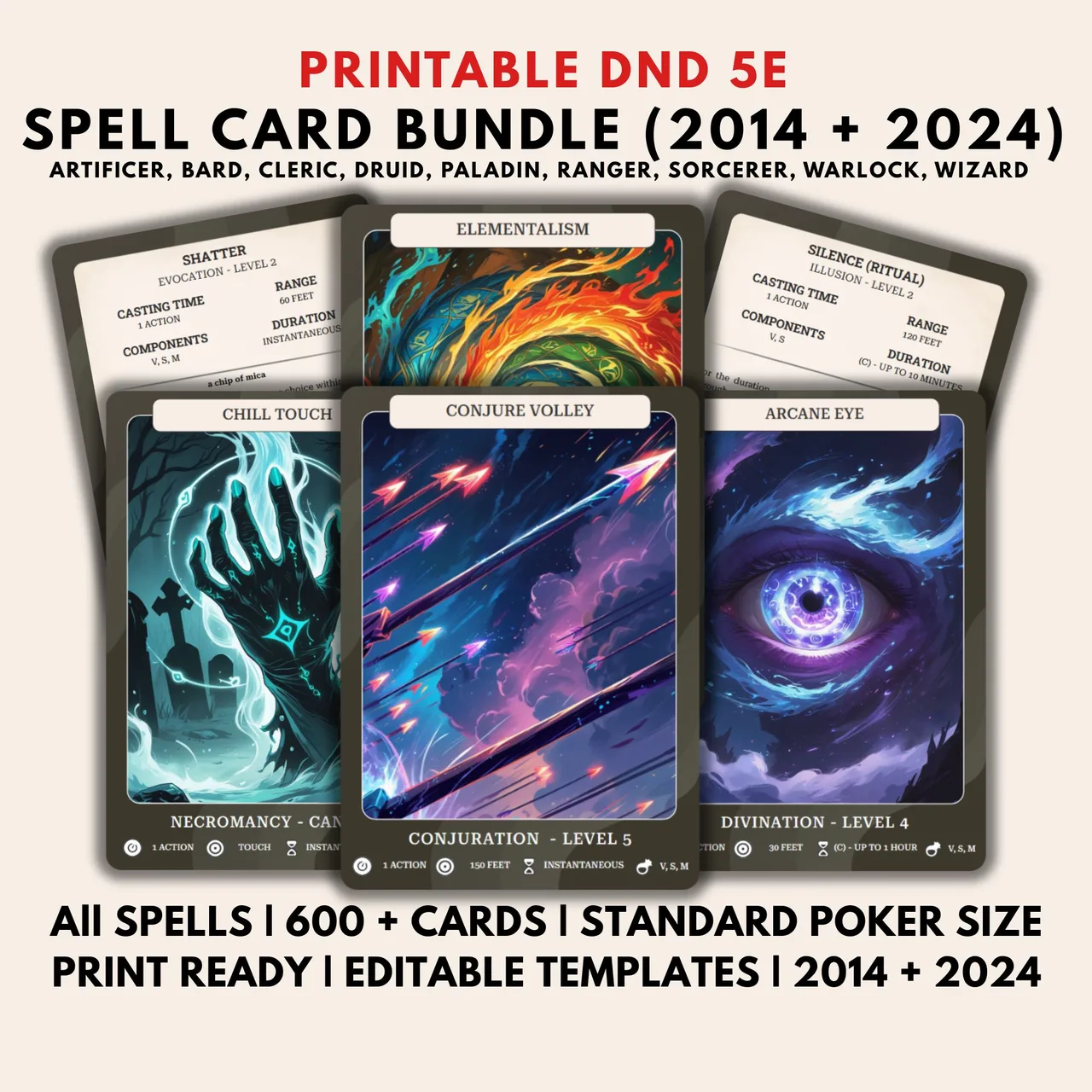
Most casters track spells in one of three ways: the official spell list in the back of the PHB, a digital tool like D&D Beyond, or a hastily scrawled sheet of paper. All three have the same problem: the spells are abstract until they’re cast. The player sees a name, maybe a level number, and that’s it. They don’t engage with the spell as a thing they own.
Physical cards flip that. A wizard with twenty spell cards laid out in front of them is making a different decision than a wizard scrolling a digital list. The cards are tactile, sortable, visible to teammates. You can fan them out and ask “which of these solves this problem?” You can flip a card face-down when a slot is spent. You can pass a scroll to another player by literally handing them a card.
The other thing physical cards do, and this is the one DMs notice, is they speed up turns. A caster who has to look up counterspell takes ninety seconds. A caster holding the counterspell card takes ten. Across a four-hour session with three casters, that’s an enormous amount of recovered table time.
Poker vs tarot size: which is right for your table
Spell cards come in two standard sizes: poker (roughly 63 x 88mm) and tarot (roughly 70 x 120mm). Both work. They solve different problems.
Poker size
Poker cards fit in standard card sleeves, deck boxes, and binders. They’re cheaper to print and easier to shuffle. A wizard with 30 prepared spells can fan them out without taking up half the table. The downside is the smaller surface: text-heavy spells like wish or simulacrum either get cramped or spill onto a second card.
Choose poker size if your players have a lot of spells, or if you want them to fit in deck boxes and travel cases.
Tarot size
Tarot cards give every spell room to breathe. Full descriptions fit on one face. Illustrations are large enough to actually see. The trade-off is desk space: a sorcerer with 15 spells laid out in tarot size will dominate a quarter of the table.
Choose tarot size if you value readability over compactness, or if your players prefer one card per spell with room for art.
There’s no wrong answer. Most tables we’ve seen settle on poker size because the deck boxes are easy to find and players can carry their decks between sessions. But if you’re the kind of DM who values the visual moment of a player slapping down a tarot-sized meteor swarm card, that’s a real consideration.
Illustrated or text-only?
Text-only cards are functional. They tell you the range, the components, the duration, the damage. They’re what most spell card sets default to.
Illustrated cards do something different. They give the spell a visual identity. Eldritch blast with a piece of original art on the face becomes a thing the player recognises and reaches for, not just a word on a list. Newer players especially benefit, because they’re learning fifty spells at once, and visual anchoring helps.
The downside of illustrated cards is they’re harder to make well. Bad art is worse than no art. A pack of illustrated spell cards is only worth the upgrade if the illustrations are consistent in style, evocative of the spell, and not just generic fantasy stock images dropped on a card.
If you’re choosing between text-only and illustrated, the question to ask is: do my players engage more with words or with images? Most groups have a mix. Many DMs end up keeping a text-only set for reference and an illustrated set for handouts and signature spells.
2014 edition vs 2024 edition: do you need both?
The 2024 5e revision changed a lot of spells. Some were renamed. Some had their effects adjusted. Some were removed and replaced. If you’re running a 2024 game, 2014 cards will mostly work but will be subtly wrong on a handful of spells, and that’s a recipe for arguments at the table.
If you’re running 2014 5e, stick with 2014 cards. If you’re running 2024, get 2024 cards. If you’re running a long campaign that started in 2014 and you’re not migrating mid-campaign, 2014 cards are fine.
The one case where you might want both: a DM who runs multiple groups, some on the old edition and some on the new. A complete spell card collection covering both editions is one purchase that handles both tables for years. Worth it if you’re in that situation. Otherwise, get the edition you actually play.
How DMs use spell cards (not just players)
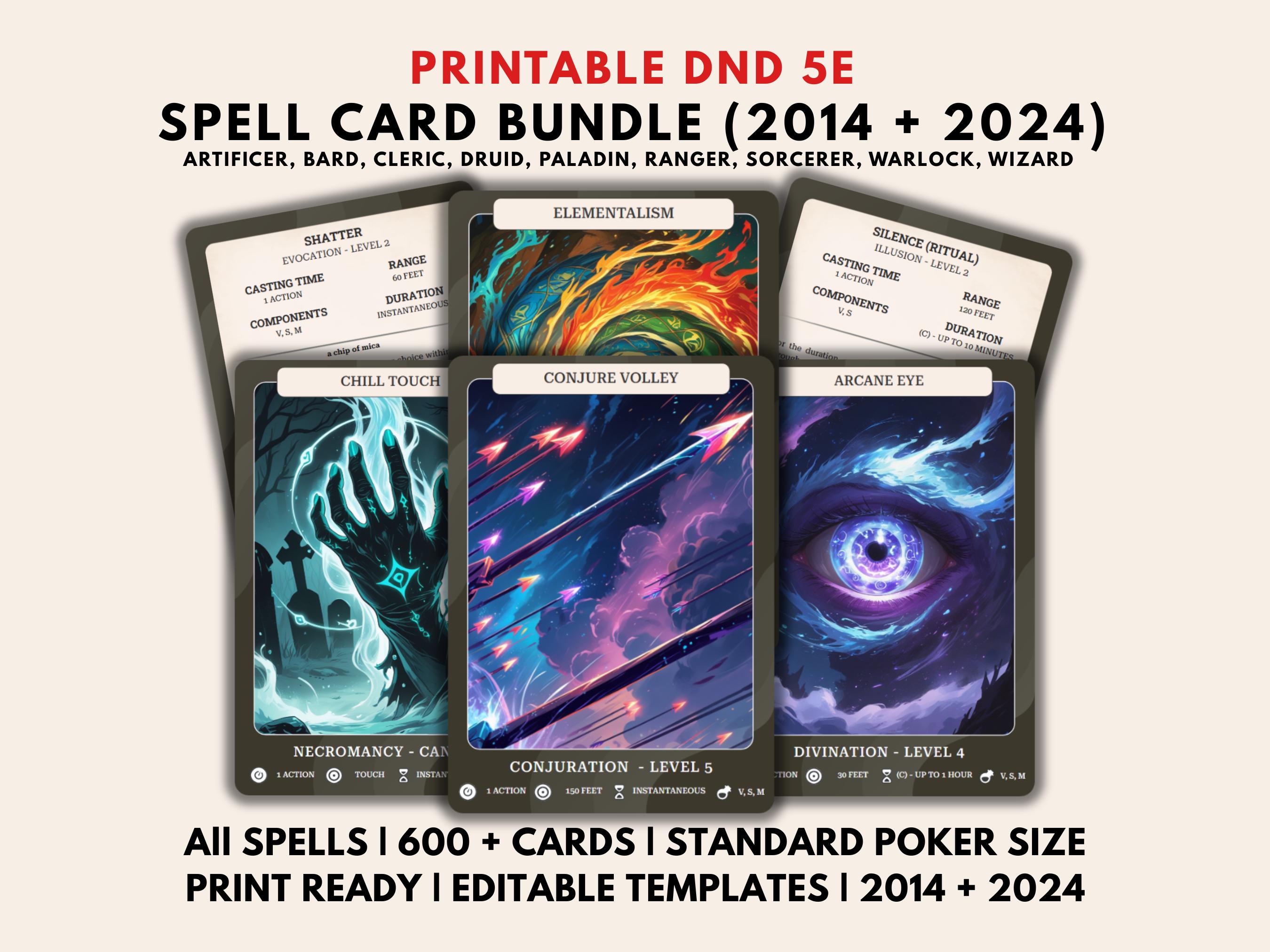
Spell cards aren’t just a player-facing tool. DMs use them too, and often get more value out of them than the players do.
For NPC casters, spell cards mean you don’t have to pre-write a stat block with every spell description. Pull the cards for the spells the NPC knows, stack them, and you’ve got a working spell list ready to play. This is especially useful for one-shot villains where you don’t want to spend an hour prepping a custom spellbook.
For scrolls and treasure, hand the player the actual card. A fly scroll handed across the table as a physical object is more memorable than “you find a scroll of fly.” The card becomes a prop the player keeps until they cast it, then returns.
For monster spell-like abilities, cards work as quick-reference for things like dragon breath weapons or beholder eye rays. Stack them in turn order and flip through.
For player handouts, ancient libraries become visual when you hand the players actual cards representing the spells they find. A spellbook isn’t a list anymore. It’s a deck.
Where to get printable DnD spell cards
The MakeMythic spell card collection is built around two products that cover both use cases.
The All Classes Spell Cards Bundle ($44 $13.20) is the comprehensive option: every class, every spell, both 2014 and 2024 editions. Print as many as you need. If you run multiple campaigns or you want one set that handles every player who ever joins your table, this is the one.
If you specifically want illustrated cards, the kind that give each spell a visual identity, the Illustrated Spell Cards Bundle ($44 $13.20) is the same scope with original art on every card. It’s heavier on file size but transforms how the cards feel at the table.
Both are printable PDFs. You print them at home or send to a print shop. No shipping, no waiting, and you have spell cards on the table the night you buy them.
Frequently asked questions
- What size should DnD spell cards be?
- Poker size (63×88mm) fits deck boxes and suits large spell lists. Tarot size (70×120mm) gives more room for art and full spell text but takes up more table space. Most tables settle on poker size for portability.
- Do I need separate spell cards for 2014 and 2024 DnD 5e?
- Yes. The 2024 revision changed, renamed, and removed spells. Using 2014 cards in a 2024 game creates discrepancies on specific spells. Get the edition you actually play; a complete bundle covering both is only worth it if you run multiple groups on different editions.
- Can DMs use spell cards or are they just for players?
- DMs get significant value from spell cards. They work for NPC spellcasters (pull the cards for the spells the NPC knows), player-found scrolls handed across the table as props, and quick reference for monster spell-like abilities.
- Are illustrated spell cards better than text-only?
- Illustrated cards give each spell a visual identity that helps players remember and reach for specific spells. Text-only cards are more functional but less engaging. Many DMs keep a text-only set for reference and an illustrated set for handouts and player-facing use.
- Where can I buy printable DnD spell cards?
- MakeMythic on Etsy sells illustrated and all-classes spell card bundles covering both 2014 and 2024 5e editions. Both are instant-download PDFs you can print at home or at a print shop the same day you buy them.
Keep reading
From the shop
Battlemaps, spell cards, and magic item cards, ready to print.
Browse MakeMythic on Etsy →