D&D shop and tavern prices: running commerce without a shopping session
How to price goods, stock shops and run taverns in D&D 5e without losing an hour to inventory. Practical prices, availability rules and a faster way to handle buying.
Every DM has lost forty minutes to a shopping session. It happens the same way each time: a player asks whether the town has a hooded lantern, you check the equipment list, someone else asks about arrows, and now five people are reading page 150 of the Player’s Handbook while nothing happens.
The fix is not better price tables. It is deciding what exists before anyone asks, and then running the purchase as a conversation rather than a transaction.
Availability beats price
The price list in the Player’s Handbook is fine. It is also almost irrelevant, because after level 3 the party can afford essentially all of it. What actually creates texture is what they can find.
A fishing village has rope, oil, salted rations, a leather jerkin someone outgrew, and nothing else. No martial weapons. No armour above leather. If the party wants a longsword they can commission one and come back in a month.
A garrison town has weapons, shields, and mail, sold by someone who wants to know why you are buying. It has no jewellery, no books and no luxuries.
A mining town has picks, lanterns, oil, climbing gear and a black market in whatever comes out of the ground.
A city has everything, and nobody asks any questions, which is its own kind of information.
This is the single highest-value decision you make about commerce, and it takes ten seconds per settlement. It also does worldbuilding for free — players learn what a place is by what it will sell them, which is far more effective than describing the local economy.
Prices worth knowing
You only need a handful memorised. These are the 5e standards:
| Item | Cost |
|---|---|
| Ale, mug | 4 cp |
| Ale, pitcher | 2 sp |
| Meal, modest | 3 sp |
| Meal, fine | 8 sp |
| Room, poor / night | 1 sp |
| Room, modest / night | 5 sp |
| Room, comfortable / night | 8 sp |
| Rations, 1 day | 5 sp |
| Rope, hempen 50 ft | 1 gp |
| Healer’s kit | 5 gp |
| Longsword | 15 gp |
| Chain mail | 75 gp |
| Riding horse | 75 gp |
Learn the top half. Anything above a few gold can be improvised and nobody will check.
The useful trick is contrast. If ale is 4 copper everywhere and then costs 2 silver in this town, the players will ask why. That is a plot hook delivered through a price list, which is a very cheap way to signal that something is wrong — a siege, a failed harvest, a cartel.
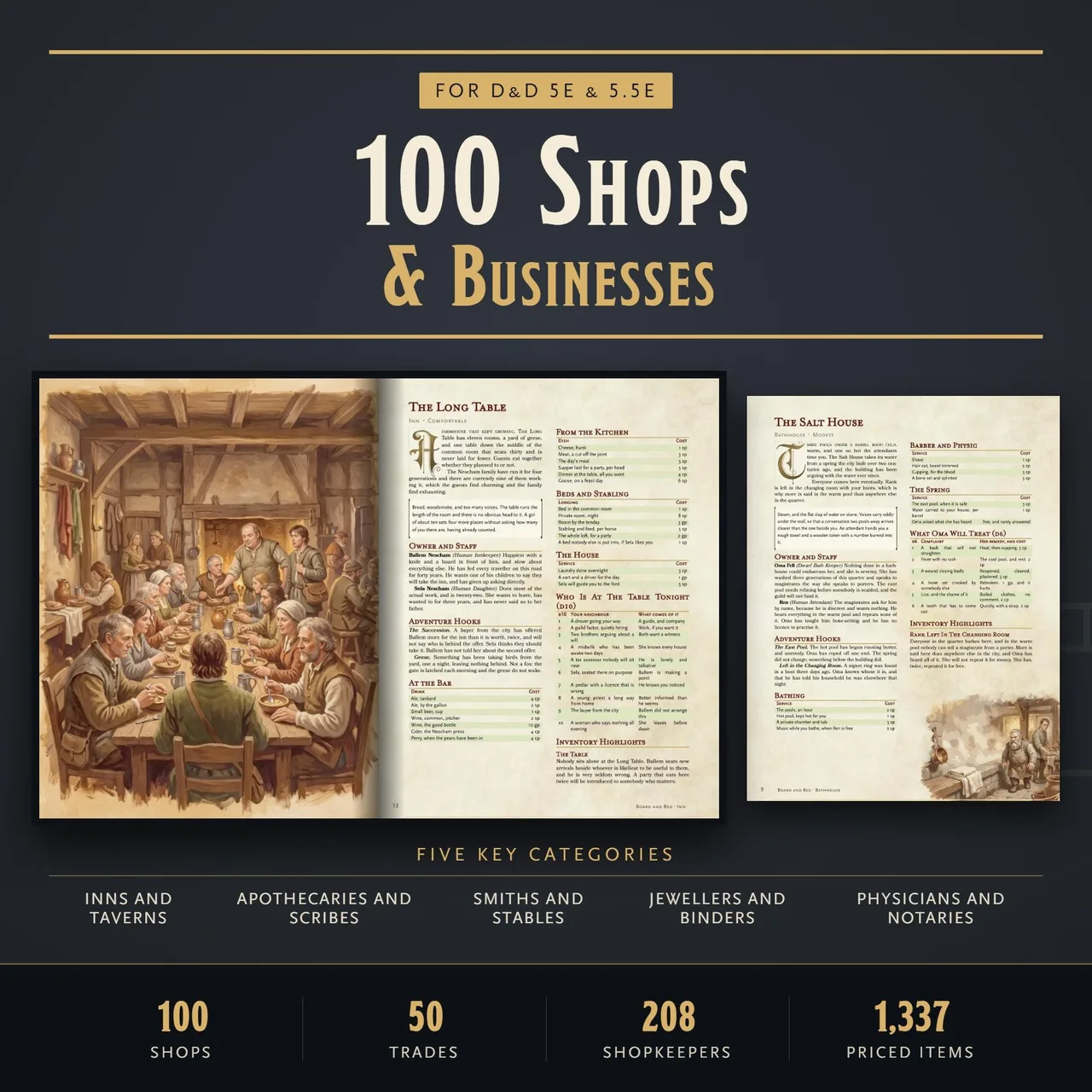
The reason shopping stalls is that the answer to “what do they have” has to be invented at the table. Having a hundred shops, taverns and businesses already written — each with stock, prices and the person behind the counter — turns the question into a lookup you have already done. The party walks into a town you did not plan for and the ironmonger already exists.
Running the purchase in one exchange
The slow version is item-by-item. The fast version is a single scene.
Player: We want to restock before we head north. You: Halvard has rope, oil, rations, and a crossbow he has been trying to sell for a year. He is asking eighty gold for the lot, which is about twenty too much, and he will tell you the north road has been bad since midsummer.
One exchange. The players got their supplies, a price, a rumour and a character. Nobody opened a book.
Three rules make this work:
Decide the stock before they ask. Even a mental list of four items is enough. Improvising an inventory while five people watch is what kills pace.
Give the shopkeeper an opinion. About the goods, the party, the road north, anything. A shop with a person in it is a scene; a shop without one is a menu.
Say yes to the ordinary. Rope, torches, rations, arrows — never make these a negotiation. Save friction for things that matter.
Haggling, once
Let players haggle. Let them do it once per shop, with a real stake.
A successful Persuasion check gets ten to twenty percent off, or a favour thrown in. A failure should cost something — a worse price, a shopkeeper who remembers them, an offer taken off the table. If failure costs nothing, players will haggle on every purchase forever, because it is free.
Do not allow a second roll from a second character. That is the whole problem with skill challenges in miniature.
Taverns are not shops
The tavern is where the party spends the most time and the least money, and it should be run completely differently. Nobody cares what the stew costs.
What a tavern needs:
- A name that tells you something. The Broken Oar is a port. The King’s Rest is pretending. The Empty Net is in trouble.
- One staff member with a personality. Not a whole roster.
- Who else is drinking here. This is the actual function of a tavern — it is the room where the party meets people. Two or three other patrons, one of whom has a reason to talk to them.
- A reason it is this tavern. Cheap, discreet, close to the docks, the only one that will take them.
The best use of a tavern is as the place where rumours arrive. Our town-building guide covers the three-rumour structure, and tavern battlemaps covers what to do when the conversation stops being a conversation.
Magic items: decide in advance
The hardest commerce question is magic items, and it should never be answered improvised at a counter.
Decide before the campaign starts, and tell the players in session zero:
- Nothing is for sale. All items come from adventure. Cleanest, and makes every item meaningful.
- Consumables only. Potions and scrolls buyable, permanent items story-only. This is the option most tables land on, and it removes the pressure without opening the floodgates.
- Open market. Everything has a price. Works for high-magic settings, but you are now running an economy, so be ready for it.
The 2024 rules are more relaxed than 2014 about common and uncommon items being available, so if you are running the newer ruleset the middle option is the default assumption. How to run a magic shop covers doing it as a scene worth playing, and the magic item generator will stock a shelf when you need one on the spot.
Selling loot
Players will try to sell everything that is not nailed down, and the standard answer — half price — is correct but boring.
Better: half price, and the buyer is a person. Who in this town buys twelve orcish scimitars, and what do they do with them? That question is more interesting than the gold, and often turns into the next hook. Our loot tables guide covers generating hoards worth selling, and the loot generator will roll one mid-session.
The short version
Availability, not price, is what makes commerce interesting. Decide what a settlement stocks before the party asks, run the whole purchase in one exchange with a shopkeeper who has an opinion, allow one haggle with real consequences, and settle the magic item question before the campaign starts. Shopping should take four minutes and produce a rumour.
Frequently asked questions
- How much does a night at an inn cost in D&D 5e?
- The Player's Handbook lifestyle expenses give squalid at 1 copper a day up to aristocratic at 10 gold. For a single night's room, poor is around 1 silver, modest 5 silver, and comfortable 8 silver. Most tables use modest as the default and never look it up again.
- How do I stop shopping taking up a whole session?
- Decide what the shop has before the players ask, handle the whole transaction in one exchange rather than item by item, and put anything genuinely interesting in the hands of an NPC with an opinion. Shopping drags when it is a lookup rather than a scene.
- Should players be able to buy magic items in D&D 5e?
- That is a campaign decision, and it should be made in session zero rather than the first time someone asks. The 2024 rules are more permissive than 2014 about common and uncommon items. A middle path — consumables freely available, permanent items only through story — works for most tables.
- How much should a meal and a drink cost in D&D?
- A mug of ale is 4 copper, a pitcher 2 silver, a decent meal 3 silver and a fine one 8 silver in the standard 5e price list. The useful part is not the numbers but the contrast — a town where ale costs a silver is telling the players something.
- What should a small village shop actually stock?
- Rope, oil, rations, common tools, and whatever the settlement produces. No armour above leather, no martial weapons, no adventuring gear that is not also farming gear. Scarcity is what makes a city feel different when they reach one.
- How do I handle haggling in D&D?
- Allow one roll, with a real cost for failure — a worse price, a shopkeeper who now dislikes them, or an offer withdrawn. Repeated haggling rolls on every purchase turn commerce into a minigame nobody enjoys.
Keep reading
From the shop
Battlemaps, spell cards, and magic item cards, ready to print.
Browse MakeMythic on Etsy →